Title

Title
Tally Ho!

Saturday, 12 May 2018

Armati Pyrrhic Wars - Mount Eyrx 277BC

Following his failed attempts to block Roman expansion in Italy, Pyrrhus crossed into Sicily to support the Greeks against the Carthaginian occupiers. The Pyrrhic army was more hard-core for this game featuring a return to a mostly phalangite-based infantry force, albeit featuring reduced numbers of the elite Eiporate troops. The Carthaginians were the usual polyglot force of mercenaries from Gaul, Spain, Italy and Africa. This was not the army of Hannibal so lacks the veteran infantry and elephants.

The field was fairly open but the Carthaginians occupied a low rise that dominated the north of the battlefield. Largely their infantry was inferior to the so they deployed it on the low rise. There right was heavily loaded with cavalry, Celts and Spanish LHI. The left was refused with a small cavalry force guarding the flank.  

Punic cavalry backed by lights

Main  infantry line with Celt on the right flank

The flank guards

Pyrrhus also sought to attack on his right with the cavalry deployed there. His elephants were held in reserve, with a small infantry force guarding their left.  

Successor main force


Successor cavalry force

The flank guards
The Carthaginians pushed forward on their right with their large cavalry force. already deployed at an angle to reduce the need to wheel. Moving rapidly they engaged the Peltasts and light cavalry holding the Successor's left.      


Punic forces advance 

Pelasts under attack as the Celts close-in

This forced Pyrrhus to begin redeploying his elephants to meet the flank attack. At 9" move they are surprisingly fast across the ground.

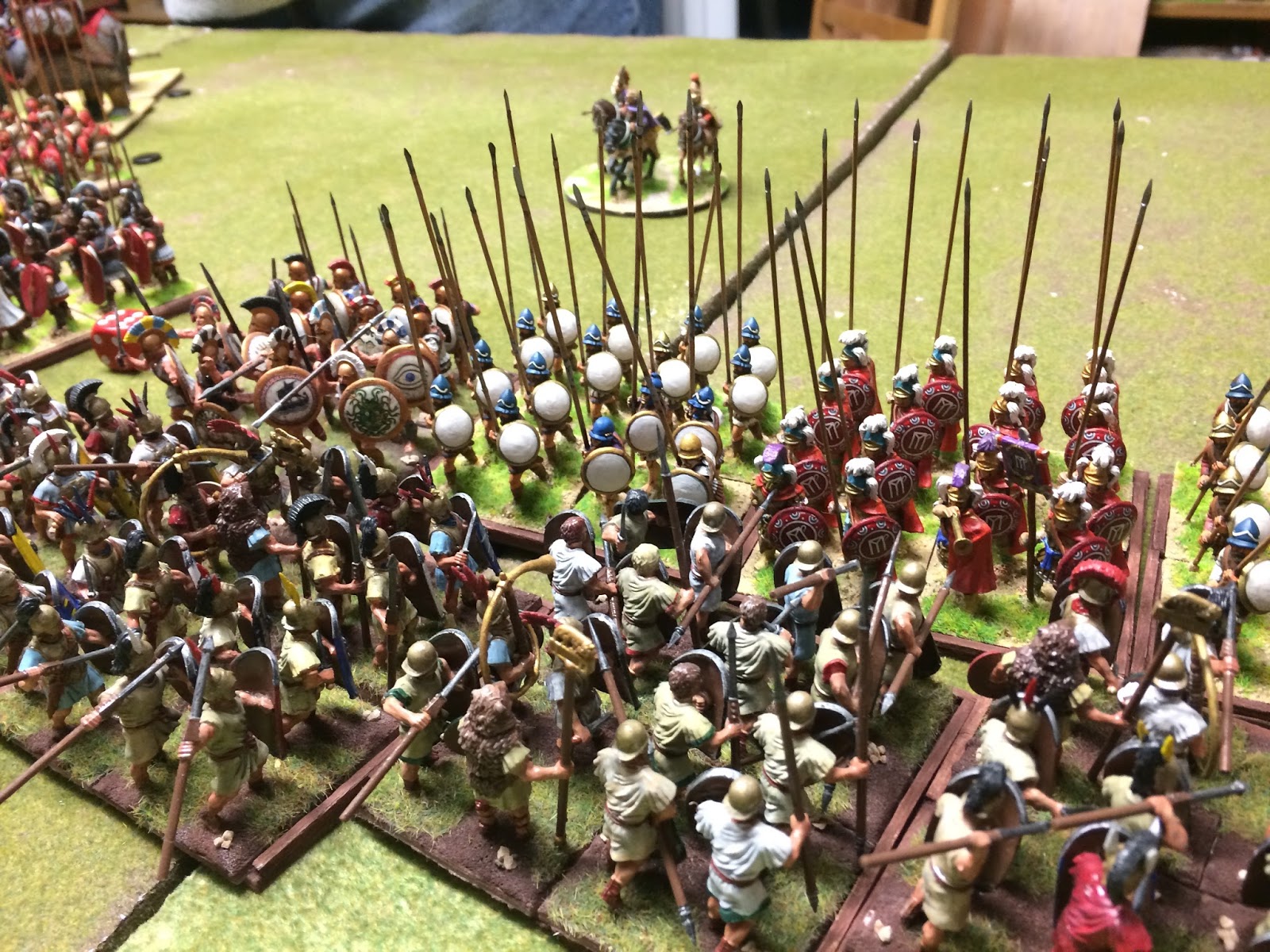
The main line of pikes 

Nelly the elephant....and friend

The successors were also planning a cavalry flanking manoeuvre of their own. However found themselves harassed, then engaged by a unit of Numidian's that cost them several vital moves as they charged them in the rear.  

Pesky LC!

The LC delay the companions 
At this point the Carthaginians were pretty well set - they had been able to delay the Successors flank attack whilst developing their own reasonably well. As a bonus the Celts had performed well and damaged a few of the pike units with their impetuous charges. The fly-in-the-ointment was that the overloaded flank was becoming congested and so they could not bring their full force into action.  

Celts get stuck in while the Spanish turn the flank

Main lines closing in

As the pikes finally came to grips with the Punic infantry they were hit in the side by the Spanish LHI. Regrettably the congestion meant it was not a deadly flank attack though.

Spanish attack 

Celts join in

On the Punic right the Successor's elephants gobbled-up some cavalry but were themselves dispatched by skirmishers. At this point losses were pretty even and the successor horse had yet to make their presence felt.

Elephants meet their maker

With neither side's flank attack really making headway it became a slog in the centre, which eventually favoured the superior Successor troops. So a win by 2 kills to Pyrrhus, making it 2-1 to him on battles won.

The pikes dish-out some pain

On reflection it was a battle that Carthage could have won if the Spanish infantry's attack been slightly better timed for maximum impact.    
 

Tuesday, 1 May 2018

Armati Pyrrhic Wars - Asculum, 279BC

Following his victory at Heraclea, Pyrrhus recruited a number of Greek and Italian allies to his cause and then set off towards Rome, but found way blocked by troops under the command of Consules Decius and Sulpicius. Not wishing to pass-up the some comedy potential they were rapidly christened Antius and Decius for our refight.

Pyrrhus force was a polyglot one consisting of elite pikes (FV8), allied pikes (FV7), Greeks (FV6), and raw Italians (FT 5 [1] 1), with the usual supporting cavalry and the elephants. Pyrrhus massed massed pikes in the centre, with the mounted/elephants on the right and the Italians holding the left. He looked set for a defensive battle, seeking to draw the enemy onto his pikes.

Italians and peltasts on Pyrrhus left

The main phalanx

The right featuring the mounted 

The Romans had a large force of heavy infantry with mainly Romans/Latins (FV7) and a few Italians (FV6), with cavalry and plentiful  skirmishers in support. For this battle they also field anti-elephant wagons which we treated as Scythed Chariots ( 5 [0] 0 and 1 BP), which we placed under the command of Antius for obvious reasons! The Romans were planning a general advance with a hope of winning on the flanks where the cavalry and Triarii were deployed.  

The Roman left, ready to take on the elephants  

Roman centre - not much to say!

The right facing off the Italians 
Both sides began with an advance on the flanks seeking to gain an early advantage against the enemy. The deployment favoured Romans on their right but the same was true of Pyrrhus deployment on hist right.
   
Pyrrhus left moves off

His right also advances

The elite pikes move up in support

In an early part of the battle Antius' anti-elephant wagons went careering across the table towards the Successor cavalry, creating a small dent (knock-for-knock job) before being annihilated, leaving a hole in the line.

Wagons roll!

hmm - that did nt last long

On their right the Romans scored an early victory by routing the Greek light horse, exposing the peltasts to a heavy cavalry charge. In a pincer movement this quickly destroys both peltasts leaving the raw Italians unsupported. Whilst the Successors left looks in trouble their cavalry inflicts damage on the advancing Romans and opens-up a possible flank attack of their own on their right.    

Roman HC eye-up the peltasts

Triarii look to slow the cavalry attack 

Italians on the march

The Romans reposition though and are able to attack the elephants with light troops, making short work of them. On their left the Triarii move up to oppose the advancing Italians and quickly blunt the attack.

Elephants in a spot of bother

The Triarii assault the Italians

As the main lines come to grips its pretty much nip and tuck with no clear winner from the initial clash of legion with phalanx.

Elite pikes advancing steadily, but under threat on the flanks

Legion vs phalanx

Crucially for the Romans their cavalry arrive in the nick of time to pin the advancing Italians and prevent them attacking the Triarii's, which allows them to break through the lines.

Roman horse make a timely arrival

The elite pikes now found themselves trapped between the Latin allied legions and the Roman heavy cavalry.  In this position there was little hope and they succumbed bravely.

Elite pikes caught in a trap

Shove!

Over on their own right the Successors were finally able to free their Companion cavalry but to late to affect the outcome. The result was a decisive 8-1 victory for Rome - truly a Pyrrhic defeat.

Finally in position but its all over
The post-match analysis was that the Successor left flank was too weak to withstand the Roman forces opposite them, meaning the flank of the phalanx was always at risk. Some bad luck on the dice making this happen quicker than may have been expected.

Tuesday, 24 April 2018

Aramti Pyrrhic Wars - Heraclea, 280BC

The opening battle of the Pyrrhic Wars took place near Tarentum in southern Italy. The campaign began with Pyrrhus crossing from Greece into Italy in response to a request for aid from the Tarentines. He found himself facing Consul Valerius Laevinus across an open field near the river Siris

Both sides were roughly equal in size but different in character.  The Romans field mostly Hastai/Principes supported by Latin allies and some cavalry. Pyrrhus had a mixture of pikemen of various qualities and crucially a small force of elephants.

Pyrrus deployed with massed pike phalanxes on his left and the weaker Greek allies mostly on the right. The left flank was occupied the heavy cavalry with skirmisher support and the right by elephants with peltasts in attendance. A cavalry attack on the left looked the main effort.

Pyrrhic left

S-pikey centre

Elephants and support

The Romans opted for a less balanced deployment. The left (opposite the elephants) contained the cavalry, light heavy Spanish, and a unit of Triarii - plenty of manoeuvrable units. The centre was a solid mass of Romans / Latins and the left had two more Triarii, offering both offensive or defensive options.  

Roman left

Solid centre

Triarii in the distance

Close-up of the pikes

The opening action was on the Pyrrhic left as he sought to protect his elephants from the pesky Spanish LHI, whilst advancing several units of Greek allies to close-down the Roman's space.

Peltasts move to cover the elephants

Romans advance

The Spanish forged ahead and were able to cut through the Peltasts with aid from some ~roman heavy cavalry. With the elephants under threat a pike unit intervened to try and slow the Roman advance.    

LHI try to reach the elephants

Some tricky manoeuvring

On the Roman right the successor cavalry advanced rapidly forcing the Triarii to deploy into blocking positions to protect the flanks of the Roman main lines. This met with mixed results - the Greeks were easily repelled but two high-rolling rounds saw the Companions dispatch one of the Romans.  

Triarii cover the flanks

Things go badly for the Roman veterans

The Companions are victorious  

The mainline clashed in the centre in a classic pilum vs pike encounter, with things pretty even in the first few rounds. In a bold move the Romans through their light cavalry into a Greek unit attempting to turn the right flank. This did not receive the luck it deserved, but did delay the attack for three precious turns.  

Clash of the lines 


Cavalry thwart a flank attack  

Over on their left the Romans had some success against the weaker Greek allies but were unable to exploit this rapidly enough to roll-up the Successors flank. The Romans also suffered as they lost a unit of heavy cavalry to the elephants.

Greek allies crumble

Romans grind forward but all too late to win 

In the end time ran out for the Romans as their right crumbled under a combined assault from the Companions and a unit of Greeks.  

Heavy going in the middle

A close battle but a win for Pyrrhus by 7-4. It was closer than that makes it seem, but the Romans had a couple of poor combat rounds at just the wrong time and so failed to destroy some of the wavering phalanx. Perhaps the deciding factor though was that the Roman horse was delayed much longer by the elephants than the Companions were by the Triarii and sol had no meaningful impact on the battle.

Pyrrhus secret weapon